Work: No Child's Business
Worldwide, 160 million children work. It is not poverty that mainly keeps child labour alive, but what communities consider normal. How do you see whether norms shift? SenseGuide tracked this for four years for the Work: No Child's Business programme, through 2,800 self-signified micro-narratives from six countries. The independent final evaluation built on what listening made visible.
In my experience, SenseMaker proved to be a great methodology to dive into norms and behaviours around complex societal issues. Given the time SenseMaker requires to unfold its potential, it provided me and my colleagues with a deep and clear understanding of how issues are framed, described and experienced by our key stakeholders: people we try to support with our work. Equally relevant, SenseMaker is a very valid approach to test assumptions we work with in our programmes. Dave and his team were able to successfully manage an assessment for one of our main programmes running in 5 countries, and impressively did this fully remotely, during COVID lockdown.
Luca Genovese, MEAL expert
The question no indicator can answer
Worldwide, 160 million children work. Anyone who wants to change that soon discovers something counterintuitive: poverty is usually not the decisive factor. Research points in a different direction. Social norms and traditions, exclusion and discrimination, and poorly functioning education systems keep child labour alive. In many communities, work is considered good for a child's character. Girls are said to need education "less". And where child labour is deeply embedded in custom, parents and children often do not realise themselves that anything is wrong.
The 'Work: No Child's Business' (WNCB) programme therefore aimed at more than getting children into school. It aimed at communities coming to see things differently — work, education, what a childhood should be. The programme ran from 2019 until the end of 2024 in India, Ivory Coast, Jordan, Mali, Uganda and Vietnam, implemented by Save the Children, UNICEF the Netherlands and the Stop Child Labour Coalition, with Hivos as lead implementer, funded by the Dutch Ministry of Foreign Affairs.
But how do you monitor whether social norms truly shift? Enrolment figures will not tell you. A norm does not live in a registry — it lives in heads, homes and habits. For that question, the alliance chose SenseGuide as one of the partners in its Monitoring, Evaluation, Accountability and Learning (MEAL) system.
The assignment: following the undercurrent for five years
Our assignment: at baseline, midterm and endline, make visible which social norms, attitudes and behaviours surround child labour in the programme's implementation areas — and whether they move. Three assessments: a baseline (winter 2020–2021), a mid-term review (2022) and an endline review (2024). Each deployment used the same signification framework and the same prompting questions, so that changes across four years are genuinely comparable. That consistency sounds obvious. It turned out to be one of the most valuable qualities of this work.
Children signify their own stories
We used SenseMaker, a narrative-based approach that its founders describe as distributed ethnography. Respondents share a short experience from their daily life — a micro-narrative — and immediately add meaning to it themselves, by answering a set of pre-defined signification questions about their own story. There is no researcher interpreting after the fact, no coding frame imposed from outside: meaning is added by the storyteller, at the moment of telling. Each micro-narrative thus yields qualitative and quantitative data at once. Thousands of self-signified stories together reveal patterns and weak signals: how a community makes sense of work, education and childhood, and whether that sensemaking is shifting.
Two parallel surveys were deployed: one for children aged 7 to 17 and one for adults — parents and guardians, teachers, community and religious leaders. Both contained identical questions, enabling direct comparison between children's and adults' perspectives. A gender lens was mainstreamed into every stage of the deployment, from framework design to analysis.
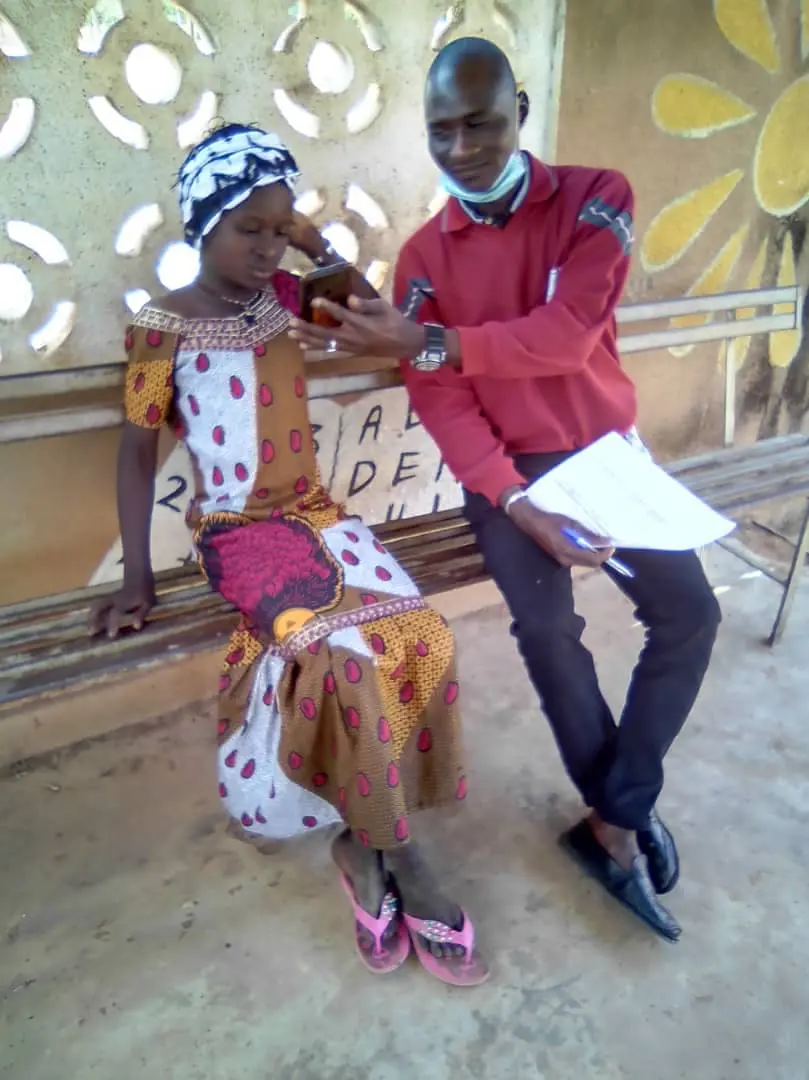
The micro-narratives were collected by people from the communities themselves. SenseGuide trained local trainers, who in turn trained story collectors from partner organisations. In local languages and trusted surroundings, story collectors reached respondents no questionnaire ever reaches. Across the full programme cycle, 1,834 children and 924 adults shared their experience — complemented at endline by stakeholders from government and the private sector (more on that below). Around 2,800 micro-narratives in total.
What the stories made visible
Baseline: four undercurrents. From the first nine hundred-plus micro-narratives, four undercurrents emerged that keep child labour in place, cutting across all focus countries: the responsibilities children feel and are assigned, social inequality — especially between girls and boys — the parent-child relationship, and the cognitive dimension. That last one proved the most stubborn: cognitive biases such as ambivalence, fear, entrenched thinking and confirmation seeking steer everyday perception without people noticing. You cannot take away what nobody experiences as a problem. Validated in collective sensemaking with the country teams, this gave the programme direction: this is where the conversations had to begin.
Midterm: good news with a warning. In 2022, nearly thirteen hundred new micro-narratives showed progress. More children attended school and awareness of child rights was growing. But the stories also surfaced something no KPI contained: many parents saw working hard — at school and beyond — as exemplary behaviour. Children gained a school day while the work at home remained. Overburdening became a real risk. On that basis we gave the programme advice that ran against the reporting logic of a large donor programme: think less in KPI outcomes, more in embedding. Getting children into school is mobilisation. Parents coming to value education for themselves is internalisation — and only internalised norms endure once a programme ends.
Endline: the norms moved. In 2024, the endline review confirmed that something had genuinely shifted. Across the countries reviewed, children reported increased school attendance and decreased child labour, particularly in hazardous conditions. Communities had visibly come to value education differently. A girl from India told us:
"Now they have got me admitted in school which has brought a lot of change in my life. Earlier I did not go to school, I used to sit at home. Earlier I used to do only household work, now I study in school along with household work."
That single quote holds both the achievement and the task ahead. The change is real: this child is in school. And the fragility is real too: the work is still there beside it. The endline named both — and was equally honest about the limits of evaluating such interwoven change: no study can claim attribution here. What it can do is trace the programme's contribution, and that is what the evidence supported.
The method grew with the task: SenseMaker for Outcome Harvesting
For the endline we broadened the deployment of SenseMaker with a second study: the SenseMaker Harvested Outcomes study. Outcome harvesting is an established MEAL practice: partner organisations actively gather evidence of the changes their interventions have brought about — tangible and intangible, in communities and in institutions. The WNCB partners harvested these outcomes throughout the programme cycle; our study validated them against the experience of those who should be noticing them.
To that end we engaged 90 government stakeholders and 73 private sector actors, from the natural stone, gold and cocoa sectors, garments and footwear, and informal and domestic work, among others. They too told and signified their own experience with the programme. Access to quality education emerged as the most frequently mentioned significant change, followed by strengthened child protection systems. Around the end of the programme, a picture thus formed from three directions — community, government and market — and the alliance could see which harvested outcomes were recognised as change beyond its own circle.
What the independent evaluation did with it
In early 2025, the external final evaluation of the WNCB programme was published, conducted by the German firm Syspons under the oversight of a reference group that included the independent evaluation service of the Dutch Ministry of Foreign Affairs (IOB) and the Royal Tropical Institute (KIT).
For the programme's core question — do norms and behaviours change? — the evaluators built on our studies. The SenseMaker studies return dozens of times as an evidence source in the final report. The recommendations for future programmes moreover include securing long-term data management partners, citing our studies as the example — precisely because comparability across baseline, midterm and endline is so rare and so valuable.
Partly on this basis, the alliance reports decreased numbers of child labourers in most programme countries. That result belongs to the programme and to the thousands of people who worked on it. Our role was more modest and more precise: making visible what happened beneath those results — and at times, as at midterm, holding up a mirror to the programme.
What this case offers programme makers, policymakers and funders
Norms do not change through ticked boxes. They change in people's heads and homes, slowly and unevenly. Anyone who leads, funds or has to decide about a programme, and wants to know whether that change is truly happening, must let people tell their own stories and signify them themselves — and sustain that for years, with a consistent framework. This case shows it can be done, at scale, in six countries and many languages, with children from the age of seven as full interpreters of their own lives.
And that an independent evaluator can then build on it. In the final report, Syspons writes about our studies — social norm change was the first pathway of the programme's Theory of Change ("Pathway 1"):
Social norm change was a key component of the programme's ToC and therefore these studies were a source of valuable information on key outcomes, especially at the household level, and therefore provided evidence to support the programme's effectiveness and impact for Pathway 1. Further, it also helped to inform the programme's activities and implementation.
Syspons, Final Evaluation Report Work: No Child's Business (2025)
The baseline, midterm and endline reports are publicly available via wncb.org.